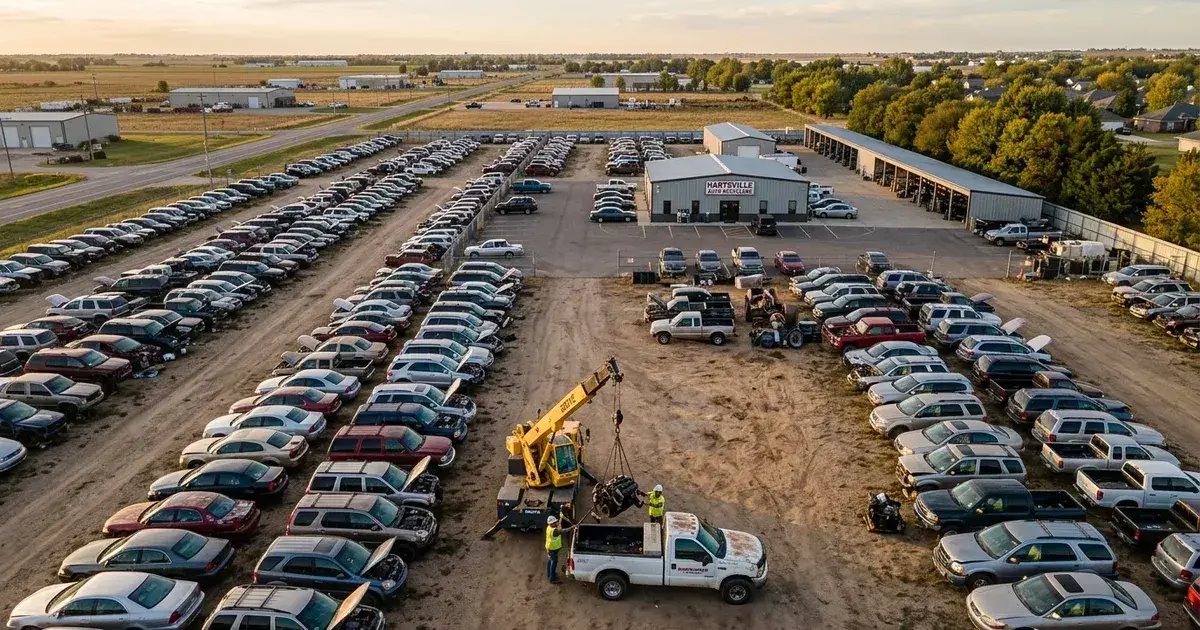
Finding used auto parts near you comes down to knowing where to look and which method fits the part you need. If you want something common, a local self-service junkyard will usually have it for cheap. If you need a specific part for a specific year and model, searching multiple yards at once through a database or voice network will save you hours of phone calls. Six reliable methods exist, and most people who do this regularly use at least two.
This guide covers every practical way to locate salvage yards and used parts in your area, what to expect when you visit, and how to decide between going local and searching online. If you already know you want to search remotely, our companion guide covers how to find used auto parts online in detail.
Key Takeaways
- Google Maps is the fastest way to find nearby yards, but it misses smaller unlisted operations
- Car-Part.com's yard locator covers 3,500+ recyclers across North America
- State recycler associations list licensed facilities that meet environmental and quality standards
- Voice networks like Hotline HQ broadcast your request to 100+ yards simultaneously for real-time answers
- Self-service yards save the most money; full-service yards save the most time
- California, Texas, Florida, and Arizona have the highest concentrations of salvage yards in the US
Six Ways to Find Used Auto Parts Near You
Roughly 9,000 auto recycling facilities operate across the United States, according to the Automotive Recyclers Association (ARA, 2024). No single search method reaches all of them, so your best move is knowing which tool to reach for depending on what you need.
Here are the six methods, ordered from simplest to most powerful:
- Google Maps and local search -- fast, visual, good for finding what's close
- Car-Part.com yard finder -- the largest recycler directory, searchable by location
- State recycler associations -- vetted, licensed facilities with quality standards
- Hotline HQ regional rooms -- live voice broadcast to 100+ yards at once
- Craigslist and Facebook groups -- free, unstructured, hit-or-miss
- Direct phone calls -- old-fashioned but effective for one or two local yards
Most people start with Google Maps. That gets you addresses, hours, and reviews. But it only scratches the surface. The methods further down this list unlock yards that don't invest in their online presence but carry exactly the part you need.
Google Maps and Local Search
The quickest way to find a salvage yard near you is to open Google Maps and search "junkyard near me," "salvage yard near me," or "used auto parts near me." Google pulls up a map with pins, ratings, phone numbers, hours, and directions.
This works well for getting oriented. You'll see which yards are closest, which ones have decent reviews, and which ones are open right now. For common parts on common vehicles, this might be all you need. Pick the closest yard with 4+ stars, call ahead, and drive over.
Where Google Maps falls short is coverage. Smaller yards, especially rural operations, often don't have a Google Business Profile or rank poorly in local search. A yard 15 miles away with exactly the part you need might not show up because a bigger operation closer to you dominates the results.
Also, Google won't tell you whether a specific yard has your part. It tells you the yard exists. You still need to call.
Tips for better local search results
- Search for the specific part type: "used transmission shop near me" or "salvage engines near me" sometimes surfaces specialty yards
- Expand the map radius manually by zooming out, then browsing pins outside your immediate area
- Check Google reviews for mentions of the vehicle make you need -- reviewers often mention specific brands a yard specializes in
- Look at the "People also search for" suggestions at the bottom of results for nearby yards Google didn't initially show
Car-Part.com Yard Finder
Car-Part.com is best known as a parts search engine indexing over 200 million parts (Car-Part.com, 2025), but it also functions as the most comprehensive salvage yard directory in North America. Their yard locator lets you search by state and city to find recyclers in your area, along with contact information and what inventory systems they use.
This is more useful than Google Maps in two ways. First, it lists yards that specifically participate in the recycling network, meaning they actively manage inventory and are more likely to be able to tell you what they have in stock. Second, you can search their inventory directly on the same site. Find the yard, then search it for your part.
If you're looking for a specific part and want to cast a wide net, Car-Part.com's inventory search will show you results from yards across the country, not just nearby ones. But for a "near me" search, their directory helps you discover local facilities you might not find through Google alone.
State Recycler Associations
Every major state has an automotive recycler association that maintains a directory of member yards. These are licensed, inspected facilities that agree to environmental standards and, in most cases, offer some form of warranty on parts.
Here are the associations for the states with the highest yard density:
- California: California Automotive Wholesalers' Association (CAWA) and various regional groups cover the state's 800+ recyclers
- Texas: Texas Automotive Recyclers Association (TARA) lists members across the state's major metro areas
- Florida: Florida Automotive Dismantlers and Recyclers Association (FADRA) covers one of the densest used-parts markets in the Southeast
- Arizona: Arizona Automotive Recyclers Association maintains a directory of desert-climate yards known for rust-free body parts
Why does the association listing matter? Because a yard that pays dues and submits to inspections is more likely to operate professionally, price fairly, and honor a return. That's not a guarantee. But it filters out fly-by-night operations that buy wrecks, strip the easy parts, and leave you with no recourse if something is wrong.
For state-specific yard directories and part availability, see our pages for California, Texas, Florida, and Arizona.
Hotline HQ Regional Rooms
*Disclosure: Hotline HQ is our product. We'll explain what it does and let you decide if it fits.*
Hotline HQ is a voice parts network that connects yards across regional "rooms." When a member yard needs a part, they broadcast the request and every connected yard in that room hears it in real time. If someone has the part, they respond within seconds. No searching. No waiting for email replies. No stale database listings.
The network currently operates active rooms in California, Texas, Florida, and Arizona, with coverage expanding. It's designed for speed and for parts that are hard to find through traditional search. Where databases show you what was in stock last time someone updated a listing, a voice broadcast confirms what's actually available right now.
This method works best when you need a part fast, when you're looking for something uncommon, or when you've already struck out on Car-Part.com and want a real-time check across multiple yards. For a deeper look at how voice-based parts sourcing works, read our guide on how auto parts hotlines work.
If you're an individual car owner rather than a yard, Hotline HQ is primarily a yard-to-yard network. But you can ask your local repair shop or salvage yard if they're on the network and can broadcast a request on your behalf.
Craigslist, Facebook Groups, and Forums
Free options exist, and they work -- sometimes. Craigslist auto parts listings show what's available in your immediate area. Facebook Marketplace and local auto parts groups can surface deals from people parting out vehicles in their driveways. Car-specific forums (model-year forums, enthusiast boards) are especially useful for older or specialty vehicles where salvage yard coverage is thin.
The downside is time. You're scrolling through unstructured listings with inconsistent descriptions, no standardized pricing, and no warranty. Scam listings appear regularly on all three platforms. There is no way to search 50 yards at once the way you can with Car-Part.com or a voice network.
When Craigslist and Facebook groups are worth your time:
- You're looking for a cheap, common part and you're not in a rush
- You need a part for an older or specialty vehicle (pre-1990, import, performance car) that salvage yards may have already crushed
- You're parting out your own vehicle and want to see local pricing before you list
- You live in a rural area with few salvage yards within driving distance
When they're not worth the effort:
- You need the part today or tomorrow
- You need a verified, warrantied component
- You're sourcing for a shop and need consistent supply
Self-Service vs Full-Service Yards
Salvage yards fall into two broad categories, and knowing the difference before you visit saves time and frustration.
Self-service yards (u-pull-it / pick-a-part)
You walk the lot, find the vehicle, and remove the part yourself. Pricing is standardized -- most self-service yards use a fixed price list based on part type, not vehicle make or model. An alternator costs the same whether it came off a Civic or a Camry.
Self-service yards charge the lowest prices in the industry. Expect to pay 50 to 70 percent less than retail salvage prices. The trade-off is labor: you need your own tools, you need to know how to remove the part without breaking it, and the experience can be physically demanding, especially in summer heat or winter cold.
Major self-service chains include LKQ Pick Your Part, Pull-A-Part, and Ecology Auto Parts. Most metro areas have at least one independent u-pull-it yard as well.
Full-service yards
The yard pulls the part for you. They typically test it, clean it, and offer a warranty (30 to 90 days is standard). You tell them what you need, they check inventory, pull it, and you pick it up or they ship it. Prices are higher than self-service, but you're paying for labor, testing, and a return policy.
Full-service yards are the better choice when:
- You don't have tools or mechanical experience
- You need an engine, transmission, or another component that's difficult to remove
- You want a warranty and the ability to return the part if it's defective
- You're buying for a customer's vehicle and can't afford to install a bad part
Which type is near you?
Search for "u-pull-it near me" or "pick-a-part near me" for self-service. Search for "auto recycler near me" or "used auto parts dealer near me" for full-service. Many cities have both types within reasonable driving distance.
What to Bring and What to Ask
Visiting a salvage yard without preparation wastes your time. Here's what experienced yard shoppers bring and ask.
What to bring
- Your own tools. Self-service yards require them. Even at full-service yards, having a socket set in the truck lets you verify fitment on the spot.
- Year, make, model, and trim level. Write it down or keep it on your phone. A 2014 Accord EX and a 2014 Accord LX use different parts in some cases.
- The old part, if possible. Bring the broken one so you can compare side by side. Connector shapes, bolt patterns, and mounting points vary between model years.
- Gloves and closed-toe shoes. Yards are full of sharp metal, broken glass, and fluids. Most self-service yards require closed-toe shoes for entry.
- Cash. Some smaller yards still prefer cash and may offer a discount for it. All yards accept cards, but asking about a cash price is worth the question.
What to ask
- "Do you have a warranty or return policy?" Get the terms in writing or at least confirmed verbally before you pay.
- "Is this the original part or a replacement?" Rebuilt or aftermarket parts sometimes end up in salvage vehicles. You want to know what you're getting.
- "Can you look up the interchange number?" Full-service yards with Hollander or Car-Part interchange data can tell you which other vehicles use the same part, expanding your options.
- "Do you deliver or ship?" Many full-service yards ship parts regionally for a flat fee. If the closest yard with your part is two hours away, shipping may be cheaper than the drive.
How to negotiate
Salvage yard pricing is more flexible than most people assume. Here's what works:
- Buying multiple parts from the same yard gives you leverage. Ask for a package discount.
- Parts that have been sitting on the shelf for months are negotiable. If a part looks dusty, ask.
- Cash discounts are common at independent yards. Ask, "Is there a cash price?"
- If you find the same part listed cheaper on Car-Part.com at another yard, mention it. Many yards will match or beat a competitor's price to avoid losing the sale.
When to Go Local vs Online
The right answer depends on what you need and how fast you need it.
Go local when:- The part is common and readily available (headlights, mirrors, door handles, body panels for popular vehicles)
- You want to inspect the part before buying
- You need the part today and can't wait for shipping
- You're comfortable removing the part yourself and want the lowest possible price
- The part is large or heavy, making shipping costs prohibitive (hoods, doors, bumper assemblies)
- The part is uncommon, discontinued, or for an older vehicle
- No local yard has the vehicle in stock
- You want to compare prices across multiple yards and regions
- You need the part shipped to a repair shop or your home
- You're looking for a specific trim-level or option-package variant
Many searches start local and go online when the local yards come up empty. That's normal. Start with the yard 10 minutes away. If they don't have it, search Car-Part.com. If that doesn't produce a result, try a voice broadcast through Hotline HQ or browse the methods in our online parts-finding guide.
For pricing benchmarks before you buy, our used auto parts pricing guide covers what to expect across common part categories.
Salvage Yard Hotspots by Region
Not all states are created equal when it comes to used parts availability. Vehicle registrations, climate, accident rates, and the age of the vehicle fleet all affect how many yards operate and what they stock.
California
The largest market for used auto parts in the US. California has over 800 licensed auto dismantlers, concentrated in the Los Angeles basin, the Inland Empire, and the Central Valley. The mild climate means less rust, which makes California yards a go-to source for body panels and structural parts shipped nationwide. Strict environmental regulations mean California yards tend to be well-run and compliant. See our full California used auto parts page.
Texas
Texas ranks second in the number of salvage yards, with heavy concentration in Houston, Dallas-Fort Worth, San Antonio, and the Rio Grande Valley. The Texas market specializes in trucks and SUVs -- Ford F-150 parts, Chevy Silverado parts, and Ram parts are always in stock somewhere. Hail damage in North Texas feeds a steady supply of late-model vehicles into the recycling pipeline. Our Texas page has more detail.
Florida
Florida's high accident rate and year-round driving season keep a large number of late-model vehicles flowing into salvage. The state has strong representation in yards carrying imports, especially Toyota, Honda, and Nissan. Coastal yards may have salt-air corrosion on some parts, so inspect carefully. Check our Florida page.
Arizona
Arizona is known for rust-free parts. The desert climate preserves body panels, undercarriages, and trim pieces in ways that yards in the Midwest and Northeast can't match. Arizona yards are a popular source for restoration projects and out-of-state buyers who need clean sheet metal. Many Arizona yards ship nationally. See our Arizona page.
Other notable regions
The Midwest (Ohio, Michigan, Indiana) has a high density of yards but rust is a significant factor on body parts. The Pacific Northwest (Oregon, Washington) feeds a steady supply of Subaru and Japanese import parts. The Northeast corridor (New Jersey, Pennsylvania, New York) has tight environmental regulations and high competition, which keeps pricing competitive.
Find the Part, Not Just the Yard
Knowing where the yards are is step one. Getting the actual part into your hands is step two, and the gap between those two steps is where most people lose time and money.
If you're searching for something specific, don't limit yourself to one method. Search Google Maps for what's close. Search Car-Part.com for what's in stock. Check your state recycler association for yards you haven't tried. And if you're still coming up empty, try a live voice broadcast through a network like Hotline HQ to reach yards that might have the part but didn't list it in any database.
The used auto parts market is big -- over $15 billion annually in the US, according to IBIS World (2025). The part you need almost certainly exists somewhere. The question is how quickly you can find it and at what price. Use the right tools, call ahead, and don't drive to a yard without confirming they have the vehicle in stock.