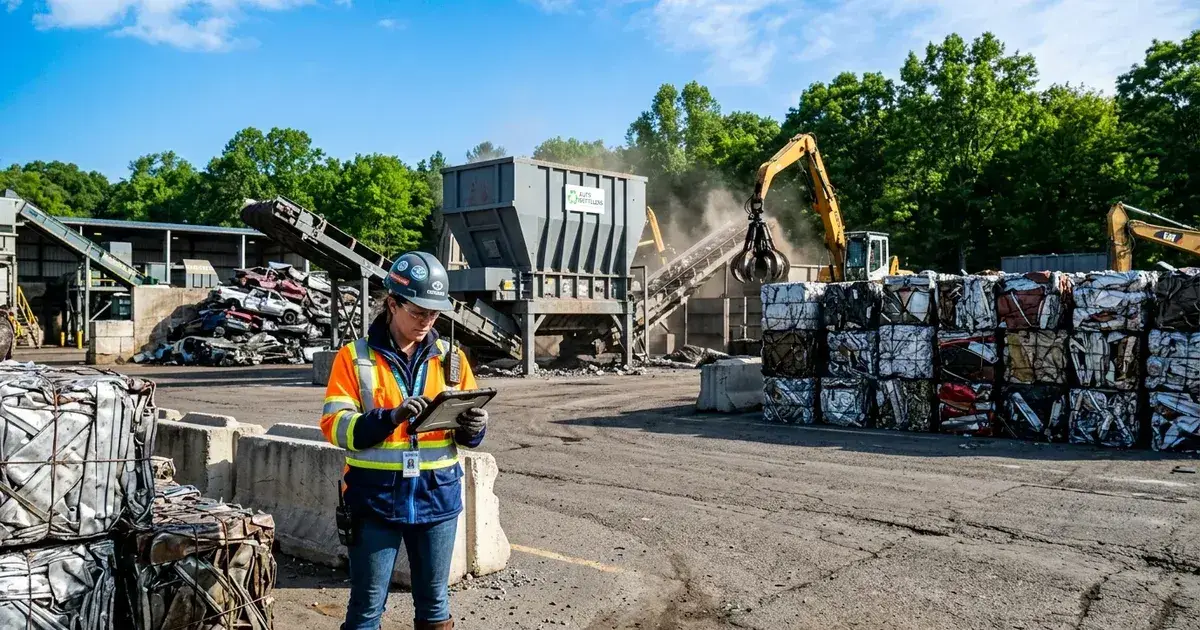
The US auto recycling industry processes 12 to 15 million end-of-life vehicles per year, generates approximately $32 billion in revenue, and operates across roughly 9,000 facilities nationwide. It employs an estimated 100,000 to 140,000 workers. By weight, automobiles are the most recycled consumer product in the country — roughly 95% of retired vehicles enter the recycling stream, and about 80% of each vehicle by weight gets recovered and reused.
Those are the top-line numbers. What follows is the full breakdown: market sizing, yard counts, employment, environmental impact, regional distribution, and the forces reshaping the industry from EVs to inventory software. If you run a yard, are thinking about starting one, or cover this industry as a journalist or analyst, this is the reference page.
Key Takeaways
- The US used auto parts and recycling market is worth approximately $32 billion in annual revenue.
- There are roughly 9,000 to 9,500 auto recycling facilities in the US, down from ~12,000 in the early 2000s.
- The industry recycles 12 to 15 million vehicles per year — about 95% of all end-of-life vehicles.
- Auto recycling recovers an estimated 14 million tons of steel annually, enough to produce nearly 13 million new vehicles.
- EVs will reshape the industry over the next decade, but gasoline and diesel vehicles will dominate the salvage stream through at least 2035.
- Technology adoption — from yard management software to voice-based parts networks — is widening the gap between modernized yards and those still operating on paper.
Headline numbers
Before the detail, here is the snapshot that matters for 2026.
| Metric | Figure | Source |
|---|---|---|
| US used auto parts market size | ~$32 billion | IBISWorld, ARA |
| Number of US auto recycling facilities | ~9,000-9,500 | ARA |
| Vehicles recycled per year (US) | 12-15 million | ISRI, ARA |
| Estimated US employment | 100,000-140,000 | BLS, ARA |
| Percentage of vehicle recycled by weight | ~80% | EPA, ANL |
| End-of-life vehicles entering recycling | ~95% | ISRI |
| Steel recovered annually (US auto recycling) | ~14 million tons | ISRI |
| Average revenue per facility | ~$3.2-3.5 million | IBISWorld |
| Global auto recycling market size | ~$70 billion | Grand View Research |
Market size and revenue
The US used auto parts and recycling industry generates approximately $32 billion in annual revenue. That makes it one of the larger segments within the broader automotive aftermarket, which the Auto Care Association sizes at over $400 billion including new parts, service, and repair.
Revenue breaks down roughly as follows:
- Parts resale: 50-60% of revenue for full-service dismantlers. This includes mechanical parts (engines, transmissions, starters, alternators), body parts (bumpers, fenders, doors, hoods), and electrical components. See our breakdown of the most-requested parts for real demand data from the Hotline HQ network.
- Scrap metal sales: 25-35% of revenue. Ferrous metals (steel, iron) make up the majority by weight, but non-ferrous metals (aluminum, copper, platinum-group metals from catalytic converters) carry higher per-pound value.
- Core sales: 5-10%. Remanufacturable cores — alternators, starters, rack-and-pinion units, engines — sold to rebuilders.
- Fluids and miscellaneous: The balance. Recovered fluids (oil, coolant, refrigerant) and ancillary revenue like towing fees, storage, and wholesale brokering.
The $32 billion figure has grown steadily over the past decade, driven by rising vehicle complexity (more expensive parts to resell), higher scrap metal prices, and longer vehicle lifespans pushing more repair-age vehicles into circulation. Adjusted for inflation, real growth has averaged 2-3% per year.
Average annual revenue per facility sits around $3.2 to $3.5 million, but the distribution is heavily skewed. The top 10% of operators — many of them multi-location chains like LKQ, Pull-A-Part, and Pick-n-Pull — account for a disproportionate share. Small single-location yards may operate at $500,000 to $1.5 million. The median is lower than the mean.
How many salvage yards in the US
The Automotive Recyclers Association (ARA) estimates there are approximately 9,000 to 9,500 auto recycling facilities in the United States. This number has been declining for two decades. In the early 2000s, the count was closer to 12,000. In the 1990s, some estimates ran as high as 15,000.
The decline reflects several overlapping forces:
Consolidation. Large operators have been acquiring smaller yards. LKQ Corporation alone operates hundreds of locations. Regional chains with 5-20 locations have absorbed many independents. Consolidation brings economies of scale in purchasing, inventory management, and online sales. Environmental regulation. Stormwater permits, hazardous waste handling requirements, and state-level environmental compliance have raised the cost of operating a yard. Older facilities on unprepared land face remediation costs that can exceed the property value. Some states require financial assurance (bonds or insurance) for environmental liability. Land costs. Salvage yards need acreage, and they typically sit on land zoned industrial or agricultural. As metro areas expand, that land becomes more valuable for development. Yards on the urban fringe face pressure to sell and relocate — or close entirely. Attrition without succession. Many yards are family-owned, second or third generation. When the current operator retires without a willing successor, the business closes. This is one of the largest single drivers of yard count decline that rarely shows up in industry reports.Despite the shrinking count, the surviving yards are generally larger, better capitalized, and more productive than the ones they replaced. Total industry revenue has grown even as the number of facilities has fallen, meaning revenue per yard has increased significantly.
How many vehicles get recycled each year
The US auto recycling industry processes between 12 and 15 million end-of-life vehicles annually. The Insurance Institute for Scrap Recycling Industries (ISRI) and ARA both cite figures in this range. The exact number fluctuates with new vehicle sales (which affect trade-in volume), average vehicle age, insurance total-loss rates, and scrap metal prices.
To put that in perspective: the US has roughly 290 million registered vehicles. Annual new vehicle sales run around 15 to 16 million. So the recycling rate roughly matches the replacement rate — the fleet turns over, and the recycling industry absorbs the outflow.
Not all 12-15 million vehicles go through traditional dismantlers. The flow looks roughly like this:
- Insurance total-losses and trade-ins enter the system through salvage auctions (Copart, IAA). Full-service dismantlers buy vehicles here, dismantle them for parts, and sell the remaining hulk to shredders.
- Self-service yards acquire vehicles from the public, auctions, and towing companies. Customers pull their own parts. After a vehicle has been picked over, the yard crushes and sells it as scrap.
- Direct-to-shredder vehicles skip the dismantling step entirely. These are typically vehicles with minimal parts value — heavily damaged, very old, or already stripped.
Roughly 80% of a vehicle by weight is recycled. Ferrous metals (steel and iron) account for the largest share. Aluminum has grown as automakers use more of it in body panels and engine components. Copper wiring, platinum-group metals from catalytic converters, and lead from batteries round out the recoverable metals.
The remaining 20% is auto shredder residue (ASR) — a mix of plastics, rubber, foam, glass, fabric, and dirt. ASR has historically gone to landfill, but new separation technologies and pyrolysis processes are improving recovery rates. The EU's End-of-Life Vehicles Directive targets 95% recovery by weight, and US recyclers are watching that standard closely.
Employment and workforce
Auto recycling employs an estimated 100,000 to 140,000 workers in the US. The Bureau of Labor Statistics (BLS) tracks employment under NAICS codes that partially overlap with the industry — motor vehicle parts (used) merchant wholesalers (423140) and scrap metal recycling. ARA's own surveys put the number toward the higher end of this range when including all facility types and related services.
The workforce breaks down across several roles:
- Dismantlers and technicians — pulling parts, testing components, cataloging inventory. This is skilled work. A good dismantler knows which parts have resale value, how to remove them without damage, and how to identify interchangeable parts across model years.
- Sales and customer service — handling walk-in customers, phone inquiries, and online orders. In network-connected yards, this includes managing requests through parts hotlines and online marketplaces.
- Yard operations — receiving vehicles, moving inventory with forklifts and loaders, crushing and baling scrap, managing hazardous materials.
- Administrative and management — purchasing vehicles at auction, compliance, bookkeeping, and increasingly, managing e-commerce and digital inventory systems.
The industry faces a workforce challenge. The work is physically demanding, sometimes hazardous, and carries stigma that makes recruiting difficult. Average wages for dismantlers and yard workers run $15 to $22 per hour depending on region, below what competing industries like construction and logistics pay. Skilled dismantlers who can handle electronics, airbags, and now EV batteries command premiums, but they are hard to find.
Parts reuse vs. scrap and shred
Not every vehicle that enters a yard gets the same treatment. The split between parts reuse and scrap/shred determines profitability, and it varies widely by facility type.
Full-service dismantlers prioritize parts recovery. A well-run full-service operation pulls 200 to 350 parts per vehicle, catalogs them in an inventory management system, and sells them through multiple channels — walk-in, phone, online, and voice networks. The remaining hulk goes to a shredder. Parts revenue per vehicle can range from $1,500 to $4,000 for a desirable late-model car or truck. Self-service yards let customers pull their own parts and charge flat or per-part fees. Parts recovery per vehicle is lower — customers take the easy, high-value items and leave the rest. But labor costs are dramatically lower. Self-service yards make their money on volume and scrap. Industry-wide, the data suggests that roughly 25-30% of a vehicle's parts by count are resold or remanufactured. The rest is scrapped. By revenue, parts resale dominates — a single engine or transmission can be worth more than the scrap value of the entire remaining vehicle.The economic incentive is clear: maximizing parts recovery before scrapping is the highest-margin strategy. But it requires labor, inventory systems, and sales channels. This is why technology adoption and network connectivity — being able to find a buyer for a part quickly — matters so much. A part sitting on a shelf for a year is inventory carrying cost. A part sold within days of dismantling is pure margin.
Environmental impact
Auto recycling is one of the most impactful recycling industries by volume. The numbers are significant:
- Steel: US auto recycling recovers an estimated 14 million tons of steel annually, according to ISRI. That is enough to produce nearly 13 million new cars. Recycled steel requires 60-74% less energy to produce than virgin steel.
- Aluminum: An increasing share as vehicle aluminum content grows. Recycling aluminum saves 95% of the energy needed for primary production.
- Oil: Recyclers drain and recover used motor oil, transmission fluid, and other lubricants. The EPA estimates that auto recyclers recover over 90 million gallons of used oil per year, which is re-refined or used as fuel.
- Batteries: Lead-acid batteries are one of the most recycled products in the US, with a recycling rate above 99%. Auto recyclers are a primary collection point.
- Tires: Roughly 30-40 million tires come off end-of-life vehicles annually. These enter the tire recycling stream for crumb rubber, tire-derived fuel, or civil engineering applications.
- Refrigerants: CFC and HFC refrigerants are captured and either recycled or properly destroyed, preventing ozone-depleting and greenhouse gas emissions.
- Mercury switches: Older vehicles contain mercury in convenience lighting switches. ARA and the EPA have partnered on collection programs that have recovered millions of switches.
The net effect is substantial. Auto recycling prevents an estimated 85 million barrels of oil equivalent in energy savings annually through materials recovery. It keeps roughly 27 million tons of material out of landfills each year.
The environmental story is also a regulatory one. Yards that fail to properly handle hazardous materials — oil, coolant, refrigerants, lead, mercury — face enforcement action, fines, and remediation orders. The industry's environmental credibility depends on proper practices at every facility, and it is one reason environmental regulation, while costly, has ultimately strengthened the surviving operators.
Where the yards are: regional concentration
Auto recycling facilities are not evenly distributed across the US. Concentration follows population, vehicle density, and climate.
The states with the most auto recycling facilities include:
| State | Estimated yards | Why |
|---|---|---|
| Texas | 800+ | Large state, huge vehicle fleet, major auction hubs |
| California | 700+ | Largest vehicle population in the US |
| Florida | 500+ | High accident rates, salt air corrosion, large retiree fleet |
| Pennsylvania | 400+ | Rust belt, older vehicle fleet, strong industrial base |
| Ohio | 350+ | Rust belt corridor, central logistics |
| New York | 300+ | Dense metro areas, high collision volume |
| Georgia | 250+ | Growing Sun Belt population, major auction centers |
| Arizona | 200+ | Sun Belt growth, low-rust vehicles (premium in other regions) |
Rust Belt states — Pennsylvania, Ohio, Michigan, Indiana — maintain high yard counts because their aging, rust-prone fleets generate steady end-of-life vehicle volume. But the parts themselves are less valuable for resale (rust damage), so these yards tend to be more scrap-heavy.
California is unique. Strict environmental regulation (DTSC oversight, stormwater requirements, CUPA compliance) has driven out marginal operators, but the remaining yards are large, well-run, and serve the nation's biggest vehicle market.
Regional dynamics directly affect how yards source and sell parts. A yard in Arizona can sell rust-free body panels at a premium to collision shops in Michigan. A yard in Texas can source late-model trucks totaled in hailstorms and sell parts nationwide. Network tools — including voice-based parts hotlines that connect yards across regions — make this cross-regional trade practical.
How EVs are changing the industry
Electric vehicles represented roughly 9% of new US vehicle sales in 2025 and are projected to reach 15-20% by 2030. For the salvage yard industry, the EV transition is simultaneously a threat and an opportunity — but the timeline matters more than the headlines suggest.
The slow wave
The average age of a vehicle at end-of-life in the US is approximately 12 to 15 years. EVs sold in meaningful volume starting around 2018-2020. That means the first large wave of end-of-life EVs will not hit salvage yards until roughly 2030-2035. For the next several years, the overwhelming majority of vehicles entering the recycling stream will remain gasoline and diesel powered.
This gives the industry time to prepare — but not unlimited time.
What changes with EVs
Fewer mechanical wear parts. EVs have no engine, transmission, exhaust system, starter, alternator, or conventional fuel system. These parts represent a significant portion of traditional parts resale revenue. An EV has roughly 70% fewer moving parts than a comparable ICE vehicle. Battery handling. EV battery packs are large, heavy (800 to 1,400 lbs for a typical pack), contain hazardous materials, and carry high-voltage risks. Dismantling an EV battery requires specialized training, equipment, and safety protocols. Several industry groups — including ARA and the Society of Automotive Engineers (SAE) — are developing standardized procedures. New high-value components. EV drivetrains include components with significant resale value: electric motors, inverters, onboard chargers, DC-DC converters, battery management systems, and individual battery modules. A salvageable battery module from a Tesla Model 3 can sell for $2,000 to $5,000 depending on capacity and health. Second-life battery market. Degraded EV batteries that no longer meet automotive performance standards (typically below 70-80% of original capacity) still have years of useful life in stationary energy storage. The second-life battery market is projected to reach $4-6 billion globally by 2030. Salvage yards that can test, grade, and sell battery modules into this market will find a new revenue stream.What stays the same
EVs still have body panels, glass, interior components, suspension parts, brakes, wheels, tires, HVAC systems (minus the compressor drive), and electronics. Collision-damaged EVs generate the same demand for body parts that ICE vehicles do. Tesla body panels, for example, are already among the more expensive parts in the salvage market.
The yards best positioned for the EV transition are those already investing in technology, training, and diversified sales channels. The ones at risk are small operators who lack the capital for battery handling equipment and training.
Technology adoption in salvage yards
The gap between technologically modern yards and paper-based operations has never been wider. Technology adoption is reshaping how parts are inventoried, priced, found, and sold.
Inventory management systems
Modern yards use electronic inventory systems that catalog every part pulled from a vehicle — make, model, year, interchange numbers, condition, location in the yard, and price. Leading platforms include Pinnacle, Hollander, and Checkmate. These systems connect to online marketplaces (Car-Part.com, eBay Motors, PartCycle) for automated listing.
A yard without an inventory system is invisible to online buyers. Given that online and phone sales now account for 30-50% of parts revenue at connected yards, this is not optional for competitive operations. For a comparison of available platforms, see our salvage yard software guide.
Voice networks and parts hotlines
Before the internet, yards found parts for customers by calling other yards on the phone. That model never went away — it evolved. Modern parts hotlines connect hundreds of yards on a shared voice network. A yard broadcasts a parts request and every connected yard hears it simultaneously. If someone has the part, they respond in seconds.
This is the model behind Hotline HQ. It works because not every part is listed in an inventory system, and not every yard is set up for online sales. Voice networks fill the gap, especially for hard-to-find parts and yards that prefer phone-based selling.
Online marketplaces
Car-Part.com remains the dominant B2B and B2C marketplace for used auto parts, with millions of parts listed from thousands of yards. eBay Motors serves a large consumer market. Newer platforms like PartCycle and Row52 (for self-service yards) have carved out niches.
The trend is toward multi-channel selling: a part is listed in the yard's inventory system, syndicated to one or more online marketplaces, available through voice network broadcasts, and sold to walk-in customers. The yards that sell fastest are the ones visible in the most places.
Vehicle acquisition tools
Salvage auctions have moved almost entirely online. Copart and IAA (Insurance Auto Auctions) run the two largest platforms. Yards bid on vehicles remotely, using condition reports, photos, and estimated parts value to set their maximum bids. Sophisticated buyers use data tools to calculate expected parts revenue per vehicle before bidding.
Growth trends and projections
The US auto recycling industry is projected to grow at a compound annual growth rate (CAGR) of 3-5% through 2030. Several structural factors support this trajectory.
Aging vehicle fleet. The average age of vehicles on US roads hit 12.6 years in 2024 and continues to climb. Older vehicles need more repairs, and used parts become more cost-effective relative to new OEM parts as vehicles age. This is the single most important demand driver for the used parts market. Rising new parts prices. OEM parts prices have increased 20-30% over the past five years due to supply chain costs, vehicle complexity, and inflationary pressure. The wider the gap between new and used parts prices, the stronger the demand for recycled parts. Insurance companies, collision shops, and consumers all have incentive to use quality recycled parts. Parts complexity and value. Modern vehicles contain more electronic modules, sensors, cameras, and driver-assistance components. These parts are expensive new and retain high resale value used. A radar sensor for adaptive cruise control, a 360-degree camera module, or an electronic power steering rack can sell for 40-70% of OEM price in used condition. Sustainability pressure. Corporate and regulatory emphasis on circular economy practices benefits auto recyclers. Insurance companies increasingly mandate or incentivize recycled parts use. Some states require collision shops to offer recycled parts options. The industry's environmental credentials — when backed by proper practices — align with broader sustainability trends. Headwinds to watch:- EV transition reducing traditional parts inventory (long-term)
- Consolidation pressuring independent operators
- Labor shortages in dismantling and technical roles
- Scrap metal price volatility affecting the scrap revenue floor
- Advanced driver-assistance systems (ADAS) potentially reducing accident frequency over time, which would lower total-loss volume
The net outlook is moderately positive. The industry will grow, but the growth will not be distributed evenly. Technologically equipped, well-capitalized operations will capture most of it. Marginal operators without digital sales channels, inventory systems, or network connectivity will continue to exit.
What this means for yard operators
If you are running a salvage yard or considering entering the business, these statistics point to a few clear conclusions.
The market is large and growing, but consolidating. Fewer yards are splitting a bigger pie. The operators who survive and grow are the ones investing in technology, training, and sales channels. Paper-based operations with no online presence are on borrowed time. Parts resale is the margin play. Scrap provides a revenue floor, but parts resale is where the margin lives. Maximizing parts recovery per vehicle — pulling more parts, cataloging them properly, and getting them in front of buyers quickly — is the single highest-leverage activity in the business. Network effects matter. A yard that sells only to walk-in customers is leaving money on the shelf. Online marketplaces, voice networks, and regional relationships multiply your effective customer base. The data on most-requested parts shows what buyers are actively looking for right now. EV preparation is a medium-term priority. You do not need to retrofit your entire operation for EVs today. But you should be tracking the training requirements, understanding battery handling basics, and watching for the first salvage-title EVs showing up at auction in volume. The yards that start learning now will have a two to three year head start when the wave arrives. Workforce is a competitive advantage. In an industry where everyone struggles to hire, the yard that can attract and retain skilled dismantlers, train them on modern vehicles, and offer reasonable wages will outperform. Good people are harder to find than good vehicles.The auto recycling industry has survived — and thrived through — every disruption of the past century: the shift from full-frame to unibody construction, the introduction of electronics, the rise of online commerce, and increasingly strict environmental regulation. The EV transition and continued consolidation are the next chapter, not the final one.