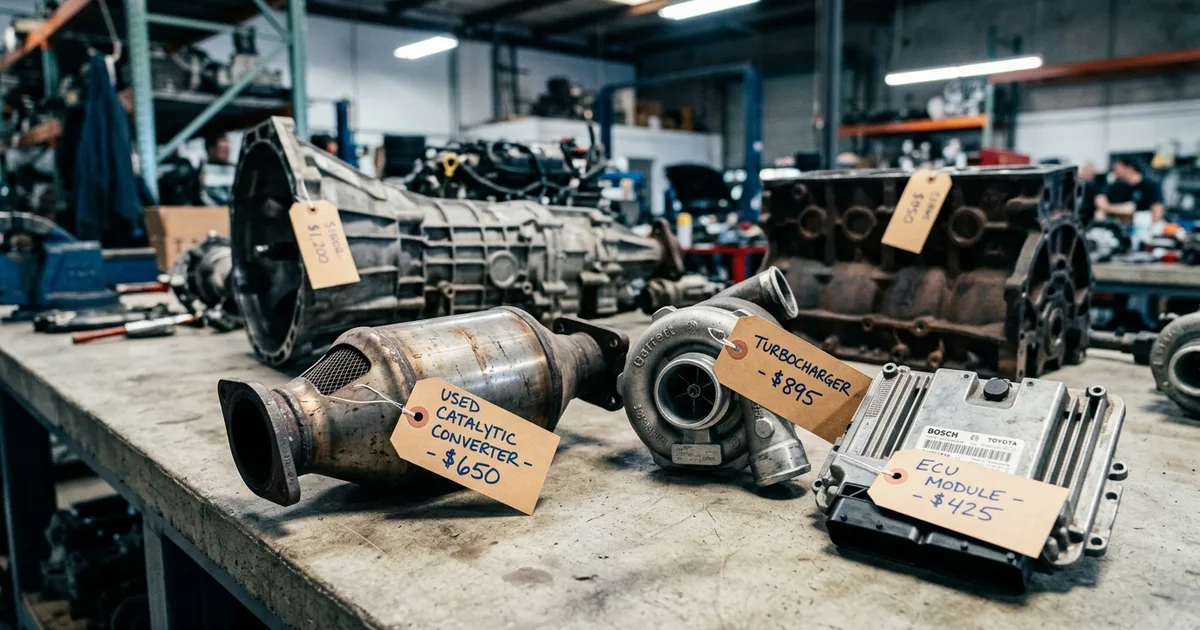
The highest-value parts at a glance
If you run a salvage yard and want to know what to pull first, here is the short answer. Catalytic converters, complete engines, transmissions, turbochargers, and factory infotainment systems are the five most valuable used auto parts by resale price in 2026. A single catalytic converter can bring $200 to $1,500. A running engine from a late-model truck clears $1,500 to $3,500. A complete automatic transmission sells for $500 to $1,500.
These five parts alone can represent over half the total revenue from a single vehicle. Pull them first, test what you can, and price them before you touch anything else on the car. The rest of this post breaks down 15 parts across three value tiers so you can build a pulling order that puts the highest-dollar items on your shelf fastest.
Key Takeaways
- Catalytic converters, engines, and transmissions are the three highest-value parts in any salvage vehicle.
- Electronics (ECUs, infotainment, headlight modules) have surged in value as dealer replacement costs have climbed.
- Full-size trucks yield the most total revenue per vehicle. Late-model Toyotas and Hondas offer the fastest turnover.
- Group your pulls by value tier: high-dollar parts first, volume sellers last.
- Testing and tagging parts adds 20-40% to resale value across every tier.
High-value tier: $500 and up
These are the parts that justify buying a vehicle at auction on their own. Each one can sell for $500 or more from the right vehicle in the right condition.
Catalytic converters — $200 to $1,500
Catalytic converters contain platinum, palladium, and rhodium. Those metals drive the price, not the converter's condition as an auto part. A converter from a 2016 Ford F-150 with a larger substrate and higher precious metal loading can sell for $400 to $800. Hybrid vehicle converters — especially from the Toyota Prius — run even higher, $600 to $1,500, because the cleaner exhaust means the catalyst degrades less over time.
A few things to know. Converter theft laws have tightened across most states. You need proper documentation proving the converter came from a vehicle your yard owns. Keep VIN records tied to every converter you pull. Buyers — whether recyclers or precious metal refiners — will ask for provenance, and legitimate buyers pay more than shady ones.
Pricing depends entirely on the specific converter model and current precious metal spot prices. Generic aftermarket converters are nearly worthless. OEM converters from trucks, SUVs, and hybrids carry the real value.
Complete engines — $500 to $3,500
Engines are the backbone of used parts revenue. A 4-cylinder from a 2017 Honda Civic or 2018 Toyota Corolla runs $500 to $1,200. V6 engines from mid-size trucks and SUVs land between $800 and $2,000. V8s from Ford F-150s, Chevy Silverados, and Ram 1500s push $1,500 to $3,500.
Mileage is the biggest price lever. An engine under 80,000 miles commands a 30-50% premium over one with 150,000+. Compression testing adds value — a tested engine with documentation sells for 20-30% more than an untested one. Full-service yards that include a 30 to 90-day warranty on engines capture the top of the range.
Diesel engines are a category of their own. A Cummins 6.7L from a Ram 2500 or a Duramax from a Silverado HD can sell for $3,000 to $5,000 in good condition. Diesel supply is tighter and rebuilding costs are steep, so used diesel engines hold their value better than gas equivalents.
For detailed pricing across all engine types, see our used auto parts pricing guide.
Transmissions — $500 to $2,000
Automatic transmissions from trucks and SUVs sit at the top of the range. A 10-speed automatic from a 2018+ Ford F-150 runs $800 to $1,500. The ZF 8-speed found in Ram trucks and several BMW models goes for $700 to $1,400. These are complex, expensive-to-rebuild units, and buyers would rather install a known-good used one than pay $3,000+ for a rebuild.
Manual transmissions sell for less — $300 to $700 for most sedans — but they move fast because the pool of available manual vehicles shrinks every year. CVTs from Nissan and Subaru fall in the $400 to $1,000 range, with Subaru CVTs trending higher because of AWD demand.
Transmissions are heavy. Factor shipping into your pricing if you sell online. Freight on a transmission runs $100 to $250 depending on distance.
Turbochargers — $300 to $1,200
The turbo market has grown alongside the shift to turbocharged engines in mainstream vehicles. Ford's EcoBoost lineup alone has put millions of turbocharged trucks and SUVs on the road. A used turbo from a 2.7L or 3.5L EcoBoost F-150 sells for $300 to $800. Units from performance vehicles — the Focus RS, Mustang EcoBoost, Subaru WRX — push $500 to $900.
Diesel turbochargers are even more valuable. A Garrett turbo from a 6.7L Powerstroke runs $600 to $1,200. New replacements cost $1,500 to $3,000 from dealers, so the used price stays strong.
Check the housing for shaft play and oil contamination before pricing. A turbo with no play and clean internals commands full price. One with detectable shaft wobble drops 40-60% or becomes a core for remanufacturing.
Infotainment and navigation systems — $200 to $800
Factory touchscreen head units have become one of the fastest-growing value categories in the parts market. A factory infotainment system from a 2019 Toyota RAV4 or 2020 Honda CR-V sells for $200 to $500. Units from luxury vehicles — the BMW iDrive, Mercedes COMAND, Audi MMI — push $400 to $800.
Dealer replacement cost is the driver here. A new factory head unit with navigation runs $1,500 to $3,000+ installed at a dealership. Used units from salvage yards cut that cost by 60-80%. The demand is steady because these systems fail, screens crack, and aftermarket replacements don't always integrate with the vehicle's other systems.
Pull these early and store them carefully. Screen damage kills the value entirely. Wrap them in bubble wrap, store face-up, and test them if you have the wiring harness to do so.
Mid-value tier: $100 to $500
Parts in this tier won't pay for the vehicle by themselves, but they stack up. A single car can yield three to six mid-tier parts, and together they often match or exceed the revenue from one high-tier component.
ECUs and electronic modules — $150 to $600
Engine control units, body control modules, transmission control modules, and ABS modules have all climbed in value. A used ECU for a 2018 Chevy Silverado runs $200 to $400. BMW and Mercedes modules push $300 to $600 because programming and dealer costs make new units painfully expensive.
These parts are small, weigh almost nothing, and ship for under $15. That combination — high value, low shipping cost — makes them ideal for online sales. The catch is compatibility. ECUs are often VIN-specific or require reprogramming, so buyers need to know exact fitment. List them with the full part number, VIN, and any programming notes.
Headlight assemblies — $100 to $500
LED and adaptive headlight assemblies from 2017+ vehicles have pushed used headlight values well above the old halogen days. A factory LED headlight from a 2020 Toyota Highlander runs $200 to $400. Adaptive LED units from German vehicles hit $300 to $500.
Dealer pricing is the reason. A new OEM LED headlight assembly from Toyota lists for $800 to $1,200. From BMW, $1,500+. Used assemblies at half that price sell fast.
Condition is everything. A clean lens with no moisture intrusion and no cracks gets full price. Hazed or cracked lenses drop the value by 50-70% or make the unit unsellable. Pull headlights early and store them where they won't get bumped. For more on headlight pricing by type, check our pricing guide.
Doors (complete) — $150 to $500
A complete door — shell, glass, mirror, regulator, handle, lock actuator — sells for $200 to $500 from a common vehicle. Truck doors sit at the high end because they are larger and more expensive new. A complete door from a 2019 Ford F-150 in the right color runs $300 to $500.
Color match is the key differentiator. A door in the buyer's exact color saves them a $300 to $600 paint job. Yards that photograph doors with clear color codes visible sell faster. Shells without glass or hardware drop to $100 to $200.
AC compressors — $80 to $400
Compressors from common vehicles run $80 to $200. Trucks and luxury vehicles push to $250 to $400. Spring and summer are peak season — demand spikes as shops replace failed compressors before the heat hits.
Testing matters here more than almost any other part. A bench-tested compressor with a warranty sells for 30-40% more than an untested one. If you invest in a compressor testing rig, it pays for itself within a season.
Bumpers (OEM, painted) — $100 to $350
Bumpers are the most-requested part on the Hotline HQ network. A painted, undamaged OEM front bumper from a 2019 Honda Accord or 2020 Toyota Camry goes for $150 to $300 at a full-service yard. Truck bumpers — especially chrome ones from F-150s and Silverados — push $200 to $350.
The value is in condition and completeness. A bumper cover with no cracks, no missing paint, and all mounting tabs intact gets top dollar. One with a repaired crack or faded paint drops to $50 to $100 regardless of vehicle.
Hoods — $100 to $400
Steel hoods from common vehicles run $100 to $250. Aluminum hoods from trucks (the F-150 went all-aluminum starting in 2015) and luxury vehicles push $200 to $400. Aluminum is lighter, harder to repair, and more expensive new — all of which keeps used prices firm.
Dent-free is the standard. A hood with minor dents can sometimes sell at a discount, but most buyers want clean panels they can bolt on and drive.
Volume sellers: under $100
These parts won't impress you one at a time. But they are fast sellers, low storage cost, cheap to ship, and they add up across dozens of vehicles. Yards that systematically pull, test, and tag volume parts generate steady baseline revenue between the big-ticket sales.
Starters — $30 to $150
Most common starters run $30 to $80. Truck and SUV starters push $100 to $150. They are small enough to fit in a shoebox and ship for $10 to $15. Bench testing takes two minutes and adds $15 to $30 to the selling price. A yard pulling starters from every vehicle and testing them on a workbench can move 10 to 20 per week without trying hard.
Alternators — $40 to $200
Same profile as starters. Compact, shippable, steady demand. Standard alternators run $40 to $100. Heavy-duty and high-output alternators from diesel trucks hit $120 to $200. Remanufactured units compete in this space, so a tested OEM alternator with a warranty is your edge.
Side mirrors — $25 to $150
Powered, heated mirrors with integrated blind-spot indicators from 2018+ vehicles run $50 to $150. Basic manual mirrors sit at $25 to $50. Mirrors break constantly — parking lot bumps, side-swipes, vandalism — so demand never dries up. They are fragile, so pull them early and store them in bins with padding.
Window regulators and motors — $20 to $80
Not glamorous. But window regulators fail on every vehicle eventually, and new ones cost $100 to $250 from a dealer. A used regulator for a 2017 Honda Civic runs $25 to $50. Pull them when you strip the door, test them with a battery, and bag them with the motor attached.
Fenders — $50 to $250
Steel fenders from common vehicles run $50 to $150. Aluminum fenders from luxury vehicles push $150 to $250. Like bumpers, condition and color match drive the price. A dent-free fender in the right color is worth three times a damaged one.
What affects a part's resale value
Five factors determine what any used part is actually worth.
Year, make, and model
Newer costs more. A 2022 part sells for 40-60% more than the same component from a 2015. Luxury and European brands carry a premium because new replacement parts from those manufacturers cost significantly more. Common domestic vehicles — Civic, Camry, F-150, Silverado — sit at lower per-part prices but sell faster because the buyer pool is larger.
Mileage and wear
For mechanical parts — engines, transmissions, turbos, compressors — mileage is the primary value indicator. Under 80,000 miles is the sweet spot. Between 80,000 and 120,000 is average. Over 150,000 drops the value by 30-50% even if the part runs fine.
Condition and testing
A tested part with documentation outsells an untested one every time. Compression tests for engines, bench tests for starters and alternators, visual inspections for body panels. The time investment is minimal. The price premium is 20-40%.
Supply and demand
Regional availability matters. Truck parts cost less in Texas where F-150s and Silverados are everywhere. Import parts cost less in California where Honda and Toyota dominate. When a model gets discontinued or a recall hits, parts prices for that vehicle spike as the pool of donors shrinks. Watching live demand on a parts hotline network gives you a real-time read on what buyers need.
Market channel
Where you sell affects your margin. Direct sales through a yard or hotline network have the lowest overhead. Online marketplaces (eBay, Facebook Marketplace, Car-Part.com) add seller fees, photography time, and shipping costs — but they reach more buyers. For more on where to sell and the trade-offs of each channel, see our guide on best places to sell used auto parts online.
Which vehicles to prioritize
Not every vehicle at auction is worth the same in parts. Here is how to think about which ones to bid on.
Full-size trucks — highest total yield
Ford F-150, Chevy Silverado, Ram 1500. These three consistently produce the most total parts revenue per vehicle. The engine, transmission, and catalytic converter alone can clear $3,000 to $5,000. Add doors, bumpers, headlights, the infotainment system, and smaller components, and a clean late-model truck can yield $5,000 to $7,000+ in sellable parts.
Truck parts also sell faster than sedan parts on the hotline network. Ford is the most-requested make on the Hotline HQ network, and the F-150 drives most of that volume.
Late-model Toyotas and Hondas — fastest turnover
Toyota Camry, RAV4, Highlander, Corolla. Honda Civic, Accord, CR-V. These vehicles don't command the highest per-part prices, but they sell the fastest. Toyota and Honda parts rarely sit on shelves because the vehicles stay on the road for 15 to 20 years. When a 12-year-old Civic needs an alternator, the owner fixes it because the car has another 100,000 miles in it.
The combination of fast sales and consistent demand makes these vehicles low-risk auction buys.
Luxury and European vehicles — high margins, slower sales
BMW 3-Series and 5-Series, Mercedes C-Class and E-Class, Audi A4 and Q5. Per-part prices run 40-60% above domestic equivalents. An ECU from a BMW that sells for $400 might be $150 from a Chevy. A headlight assembly worth $450 from a Mercedes lists for $200 from a Toyota.
The trade-off is slower turnover. The buyer pool is smaller, and fitment is more specific. But if you have shelf space and patience, luxury vehicle parts deliver strong margins.
Hybrids — catalytic converter gold
Toyota Prius, Camry Hybrid, Ford Escape Hybrid. Hybrid catalytic converters contain more precious metals and degrade less because the gas engine runs less. A Prius converter can sell for $600 to $1,500 — sometimes more than the vehicle cost at auction. The battery pack is a bonus revenue source if you have the equipment and buyer connections to handle it.
A pulling strategy that maximizes revenue
When a vehicle hits your yard, the order you pull parts determines how much money you leave on the table. Here is a practical sequence based on value per minute of labor.
First pass — high-value extraction (30 to 60 minutes). Catalytic converter, ECU and electronic modules, infotainment system, turbocharger (if equipped). These are the highest dollar-per-pound parts and the easiest to damage if you wait until the vehicle is partially stripped. Second pass — major mechanicals (1 to 3 hours). Engine and transmission as a pair if you have the hoist capacity, or individually. These are the biggest single revenue items and require the vehicle to be relatively intact for a clean pull. Third pass — body and lighting (1 to 2 hours). Bumpers, fenders, doors, headlights, hood, taillights. Pull these before the vehicle gets picked over. Photograph each panel with the paint code visible. Fourth pass — volume parts (30 to 60 minutes). Starters, alternators, AC compressor, side mirrors, window regulators. Test on the bench, tag, shelve. These sell steadily and the pulling time per unit is minimal. Final pass — remaining value. Radiator, wheels and tires, seats, steering components, fuel pump. Anything left that's sellable before the hull goes to the crusher.If you're looking for ways to sell more parts from each vehicle, a structured pulling workflow is the single biggest operational improvement most yards can make.
Where to sell high-value parts
Different parts sell better through different channels.
Hotline networks work best for parts with broad demand — engines, transmissions, bumpers, doors. When you broadcast a part on the Hotline HQ network, it reaches hundreds of yards instantly. No listing fees, no photography, no shipping logistics upfront. The buyer calls you and arranges pickup or freight. Online marketplaces are ideal for niche and high-value parts — ECUs, infotainment systems, turbochargers, specialty headlights. These parts have smaller buyer pools that benefit from national exposure. eBay, Car-Part.com, and Facebook Marketplace all work, but factor in seller fees (10-13% on eBay), photography time, and shipping when you price. Direct yard sales capture the best margins on common parts — starters, alternators, mirrors, regulators. Walk-in customers and local shop accounts move volume without platform fees.For a deeper breakdown of where to sell and the trade-offs of each channel, read our guide on best places to sell used auto parts online. You can also explore our main sell used auto parts page for a quick overview of all seven methods.